Studio 0815 · Flight & mission systems · Defense tech · 2015–2024

Nine years, one studio: first hire to department director

In late 2015 I joined Studio 0815 — a design studio working on flight and mission systems for defense — as its first employee. Nine years later I was directing a department of 3 teams, and I never stopped shipping. Below: the roles that arc covers, and three of the systems my teams and I designed for the Israeli Air Force.

Senior Product Designer · Dec 2015 – Jun 2017 Design Team Leader · 3 teams · Jun 2017 – Apr 2020 Department Director · 12 designers · Apr 2020 – Jun 2024
Israeli Air Force · mission planning & control

Project Blossom

Sole designer, then team leader of three · in use at the main command, control centers and squadrons

The Israeli Air Force's mission plan and control application, intended to serve as its main tactical tool: a wide overview of the whole military picture — air, ground, ocean, underground — from the soldier in the field to the whole campaign, plus command and control of aerial forces.

The client had also asked for a separate system to plan aerial missions before they're sent to the control app. I folded the two into one platform, so planning and controlling are performed by the same system and each user can focus on their specialty within it.

the shipped system, step by step
Forces and missions, open on the right and grouped by mission type; the map holds the picture, the tools rail the left edge.
Touch a row and the aircraft answers on the map. The list and the picture are the same objects, seen two ways.
Select it and a third representation docks at the bottom — the focus bar, where the actions live.
Altitude, heading, armament and time-on-station, without giving up an inch of the map.
The list compacts on demand: the same forces at a density the all-day users asked for.
Or closed entirely. Every panel is dismissible, because the picture is what the room is looking at.
The layers menu — world, points, lines, areas, routes, targets, landing sites, enemy — each with its count and its own eye.
This is the geo data half of the analysis, shipped as navigation.
Into routes: the collections a squadron actually keeps, not a flat list of everything ever drawn.
One route open: legs, speed, altitude, fuel and elapsed time on the map itself, with the editing tools at the foot of the screen.
Deselected, it stays on the map — visible is one thing, selected is another.
And the eye takes it off. Every user builds the view their own task needs.
Pulling back: more forces, an orbit, the shape of a sector.
Back far enough for the whole campaign — the same canvas that was showing one aircraft twelve steps ago.
planningThe other half of the platform: the same map, the same objects, building the mission before anyone flies it.
Project Blossom · case study

How it was designed

Three challenges shaped the brief

Each one pulled in a different direction, and the system had to answer all three at once — before a single screen could be considered settled.
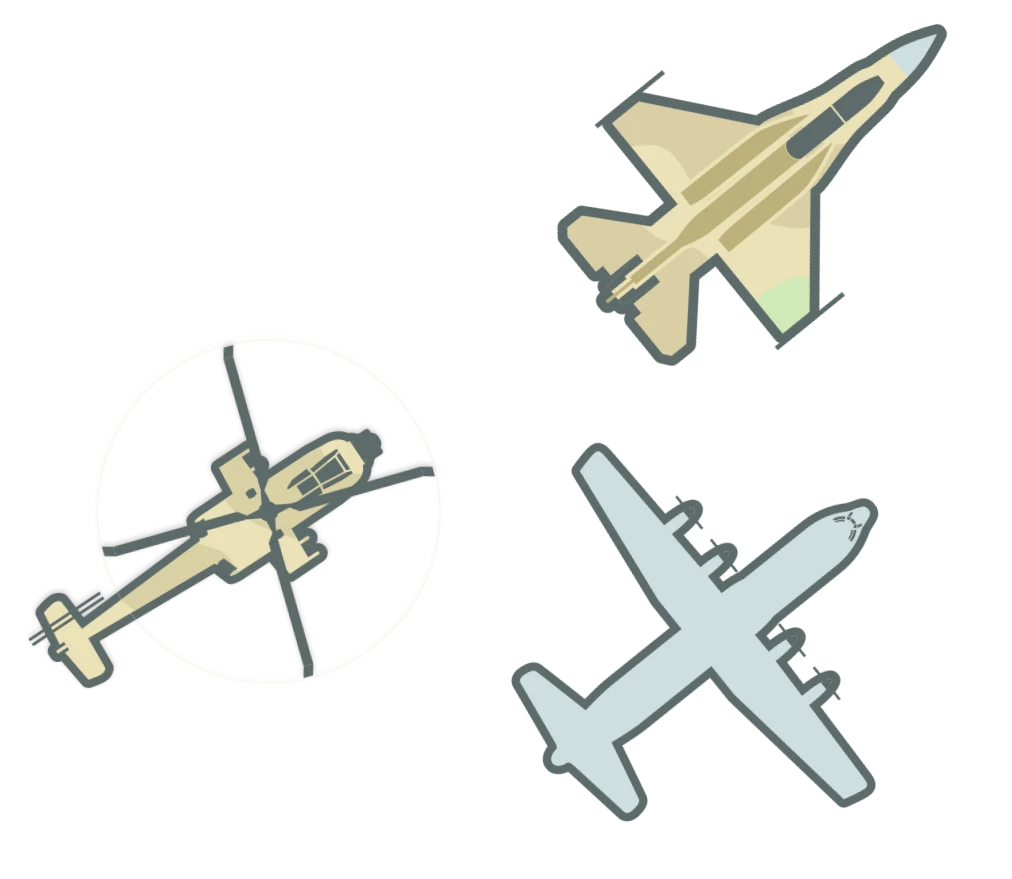
Three of Blossom's force icons — fighter, helicopter and transport — drawn top-down in the system's palette
01

Users

A wide range of user types and digital-literacy levels, from the Air Force commander to the intelligence clerk in the squadron.

02

Scope

The system had to cover a wide range of actions and present the relevant data in each view.

03

Compatibility

It had to work with the IAF's other systems and terminology.

Air Force · Intelligence Corps · General Staff

Project Buttercup

Design team leader · one designer · making a rigid workflow flexible

Buttercup plans, commissions and manages reconnaissance missions — photography and recording missions performed by drones — for the Israeli Air Force, the Intelligence Corps and the General Staff.

It replaced a workflow run on Excel, PowerPoint and email.

the shipped system, step by step
The working surface — the plans timeline in the center, resources on the right, the requests queue behind it.
One event, selected and being resized on the timeline; the +60 flag marks a scheduling conflict before it becomes one.
Right-click for its context actions: open the chat, open the full event card, or find it on the map.
Open the event and the conversation is right there — a proposed time change, sent and waiting.
And who's in it — the event's participants, each able to approve directly inside the thread.
Every event's conversation rolls up into one feed — the trail of changes and discussion history the client asked for.
The same context menu from the mission bank: confirm the event, change its times, open the chat, or jump to the map.
Project Buttercup · case study

How it was designed

The client's own list, in the client's own order

Two problems they called main, two they called secondary. The design answered the main pair directly — and, as it turned out, got the secondary pair as a side effect of the same structure.

01

Commissioning was tedious

Commissioning missions and avoiding conflicts was a tedious job: there were too many variables to consider. Main.

02

Real time was impossible

It was almost impossible to change plans or reassign missions in real time. Main.

03

Approvals were hard to track

Every action needed approval by multiple people, which was hard to keep up with. Secondary.

04

Nothing was documented

The organization needed to document the trail of changes and the discussion history. Secondary.

Israeli Air Force · squadron management

Project Bubbles

Sole designer → team of four · squadron management, for every squadron type

The Israeli Air Force's squadron management system, built to serve every squadron type — combat, transport, helicopter and drone.

Many officials plan the squadron's long- and short-term agenda together, across operational, recreational, private and collective matters.

the shipped system
monthFive weeks, color-coded by platform, with weather and light times running along the top.
weekThe same code at the week scale — one row per platform, duration and headcount totalled at the foot of each day.
weekRequesting an aircraft from inside the week: quantity, source and name, then a search for who's available.
staffingThe same week, read for who's assigned to what.
ganttThe Gantt: role assignments laid against the hour, the same color code carried straight through.
dayThe day view's other half: the aircraft itself — loadout and fuel — beside the flight list it belongs to.
Project Bubbles · case study

How it was designed

Operational and personal, on the same calendar

Squadron management means addressing operational and personal matters together, for every squadron type at once — and the bar the new system had to clear was set by what the squadrons were actually using instead of the old one.

01

Every squadron type at once

Combat, transport, helicopter and drone squadrons, on one system.

02

Long-term and short-term, together

Many officials plan the agenda side by side, across operational, recreational, private and collective matters.

03

What the squadrons actually used

The system Bubbles replaced was army-made and cumbersome; in practice, the work happened in Excel spreadsheets, Outlook email and calendar, and erasable whiteboards.

Studio 0815 · closing

Not everything I built was a product

Nine years · first employee to department director · 1 department, 3 teams, 12 designers

Three case studies show the work. The rest of the job was building the organization that could keep producing it.

01 · the training program
The pipeline that grew them
Every designer who joined Studio 0815 went through the onboarding protocol and training program I designed — about a week of tools and documents, built around one goal: a common language with the rest of the studio. Use the design system properly. Build a new component when one's needed, document it, name it so the next person can find it.
It worked: designers who joined with zero systems experience went on to own full feature areas, then lead their own teams.
02 · client strategy
Deciding what the studio would take on
Set long-term strategy and roadmaps with clients, and directed research, design and development of a suite of linked products for one defense client’s flight and mission systems.
That included owning the build-vs-adopt technology decisions — the calls that determine what a design team can actually promise.
03 · representing the work
The studio, and its clients, abroad
Represented the studio and its clients internationally — the part of directing that happens outside the building, and the part that makes the rest of it fundable.
Part of that was overseeing research initiatives abroad: sent out repeatedly to facilitate, run usability tests, and meet users directly.
And some other stuff
←Portfolio end of the 0815 page · next in the portfolio · Redis Research